Invoicing as a Kleinunternehmer in Germany: The Complete Guide
Starting a business or freelancing in Germany often involves registering as a small business owner (Kleinunternehmer). The main benefit of this status, regulated by § 19 of the Value Added Tax Act (UStG), is that you are exempt from charging, collecting, and paying VAT (Umsatzsteuer) to the tax office.
However, this simplification comes with strict invoicing rules. A single mistake on your invoice can lead to you paying VAT out of your own pocket. Furthermore, since January 1, 2025, the new e-invoicing laws (E-Rechnung) for the B2B sector are fully active in Germany, directly affecting small businesses.
Here is everything you need to know to issue legally compliant invoices as a Kleinunternehmer.
1. The Golden Rule: No VAT on Your Invoice
As a Kleinunternehmer, you must not charge VAT. Therefore, you must never show a VAT rate (e.g., 19% or 7%) or a separate VAT amount on your invoice.
If you accidentally display VAT on an invoice (for instance, by using a wrong software setting), § 14c UStG applies. This means you will owe that exact tax amount to the German tax office, even though you are technically exempt. Your invoice should only display one final total amount.
2. Mandatory Invoice Requirements
Even without VAT, your invoice must meet strict legal requirements under § 14 UStG. It must include:
- Your full name/company name and address.
- Your client's full name and address.
- Your Tax Number (Steuernummer) provided by the Finanzamt.
- Invoice date.
- A unique, sequential invoice number.
- A description of the goods or services provided.
- The time of supply or service period.
- The total amount to be paid.
If you want to be certain that you haven't forgotten any legal fields, we recommend you discover our invoice templates as a solid foundation for your billing.
3. The Mandatory Text: Reference to § 19 UStG
Because your invoice lacks VAT, you must explain why to both the client and the tax authorities. You must include a specific sentence on your invoice (usually at the bottom) referencing the law.
Standard phrasing includes:
- "Gemäß § 19 UStG wird keine Umsatzsteuer berechnet." (According to § 19 UStG, no VAT is charged).
- "Als Kleinunternehmer im Sinne von § 19 Abs. 1 UStG wird keine Umsatzsteuer berechnet."
Without this sentence, your invoice is formally incorrect.
4. The Reality Since 2025: The E-Invoicing Mandate
Many small business owners mistakenly thought digital billing laws only applied to large corporations. However, since January 1, 2025, strict rules apply to all B2B transactions in Germany:
- Receiving E-Invoices is Mandatory: Whenever you buy goods or services from another German company, you must be able to receive and process structured electronic invoices (like ZUGFeRD or XRechnung). You can no longer demand paper or simple PDF invoices. If you receive an XML invoice and need to check its technical validity, you can always use our ZUGFeRD Validator.
- Sending E-Invoices: While small businesses have a transition period before they are forced to send XML-based e-invoices, many corporate clients already expect them today.
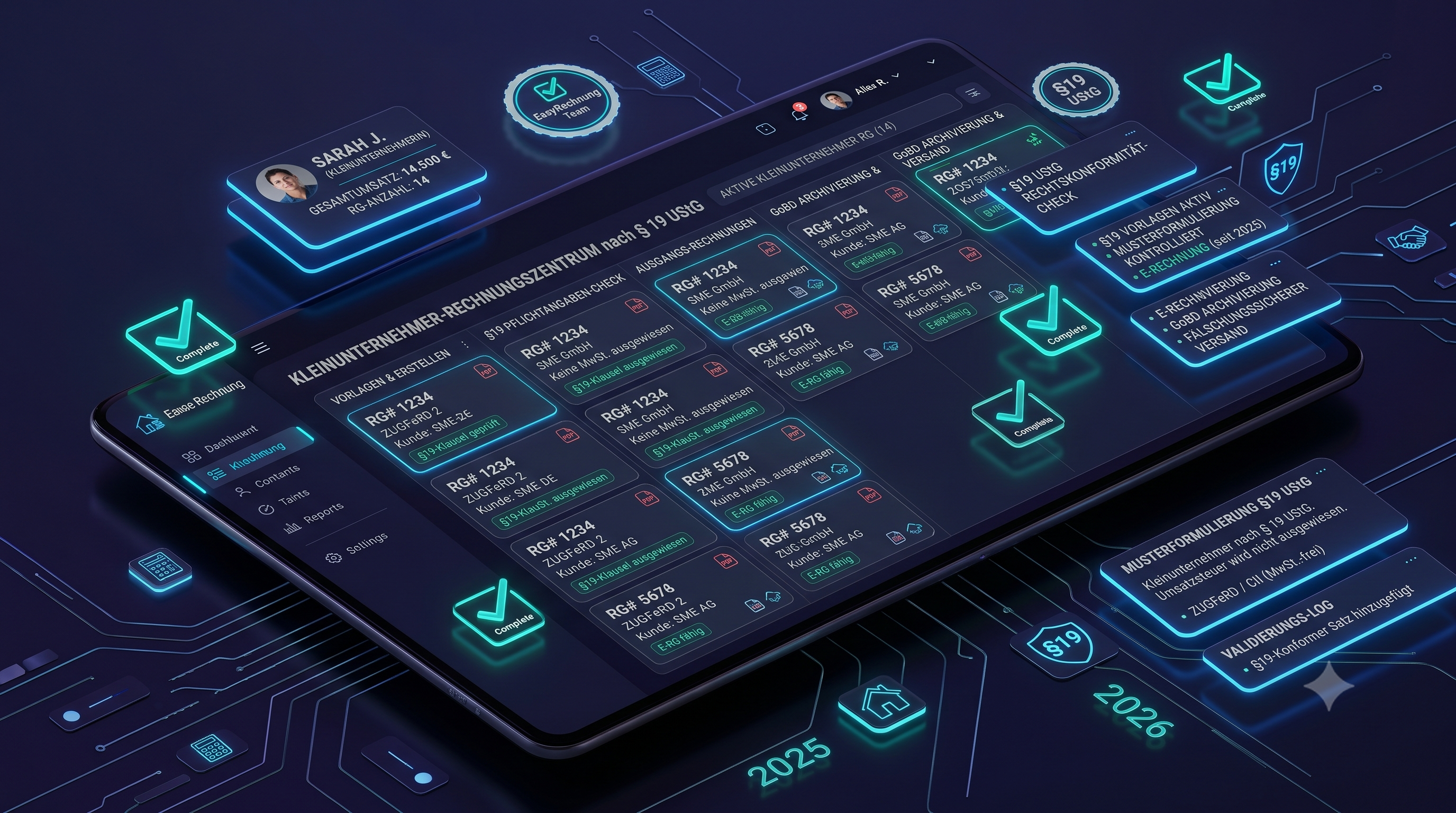
Switching to modern invoicing is easy. Using specialized software, you can create an e-invoice in seconds. The software will automatically remove VAT fields, insert the § 19 UStG reference, and generate the required XML files for your clients.
5. Key Takeaways
- Never charge VAT: Keep your amounts as a single total.
- Mandatory reference: Always include "Gemäß § 19 UStG wird keine Umsatzsteuer berechnet".
- Stay compliant: Ensure your Steuernummer and sequential invoice numbers are present.
- Embrace digital: The 2025 e-invoicing mandate is already in effect. Upgrade your billing tools to receive and send structured e-invoices easily.