ZUGFeRD 2.3 and Factur-X Explained: The Comprehensive Guide to Hybrid E-Invoices
With the 2025 e-invoicing mandate approaching for the German B2B sector, choosing the right invoice format is crucial. While XRechnung is standard for B2G (business-to-government), the private sector heavily favors a different format: ZUGFeRD, frequently mentioned alongside Factur-X.
But what makes this format "hybrid", and why is it the ideal bridge for businesses transitioning to digital workflows?
1. What Are ZUGFeRD and Factur-X? (The Definition)
ZUGFeRD is a cross-industry data format for electronic invoice exchange. Its defining feature is its hybrid structure.
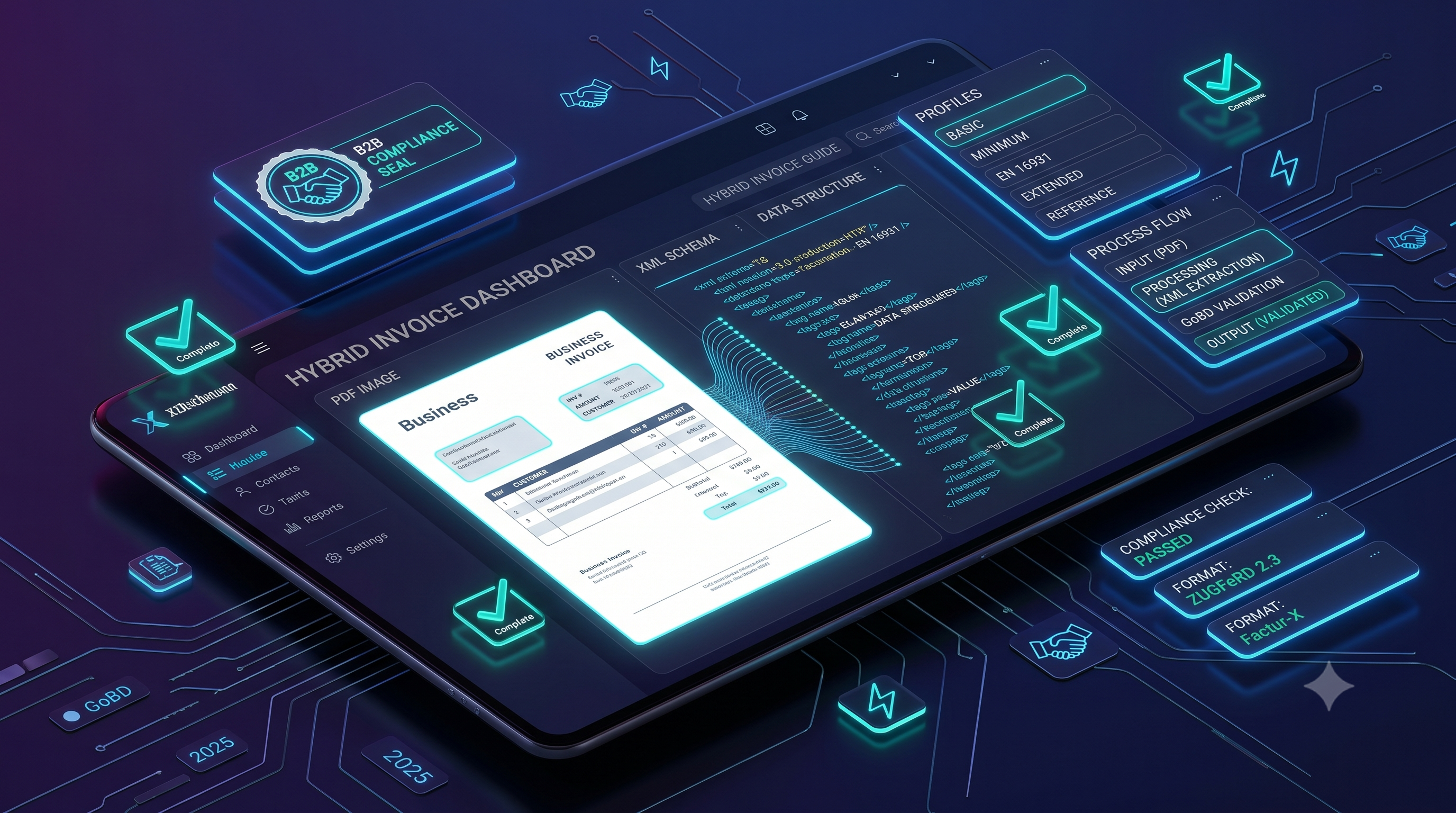
Unlike a pure XML file (which only machines understand) or a standard PDF (which only humans understand), ZUGFeRD combines both:
- The visual component (PDF/A-3): A standard document you can read, containing your logo and layout.
- The machine-readable component (XML): A structured XML dataset embedded invisibly inside the PDF. Accounting systems can extract this data automatically without manual entry.
Factur-X vs. ZUGFeRD
If you do business internationally, especially in France, you will hear about Factur-X. The most important fact to know: Since ZUGFeRD version 2.1, they are technically 100% identical. It is a joint Franco-German standard, meaning you can use the terms interchangeably for cross-border trade.
2. ZUGFeRD 2.3 Profiles Explained
ZUGFeRD offers various "profiles" to match different business complexities.
| Profile | Description | EN 16931 Compliant | Best For |
|---|---|---|---|
| MINIMUM / BASIC WL | Basic header data only, no line-item details. | ❌ No | Very simple processes, rarely used. |
| BASIC | Includes line items, but lacks some mandatory EU fields. | ❌ No (Partially) | SMEs with simple billing needs. |
| EN 16931 (Comfort) | The core profile! Contains all elements required by the EU standard. | ✅ Yes | Recommended for all B2B transactions from 2025. |
| EXTENDED | Adds industry-specific extensions and complex logistics data. | ✅ Yes (Extended) | Large corporations, complex EDI. |
Important: To comply with German legal requirements for 2025, always configure your software to use the EN 16931 profile.
3. Why the B2B Sector Loves ZUGFeRD
- Smooth Transition: Employees can still visually check the PDF document, avoiding the "culture shock" of pure XML files.
- Universal Compatibility: If your client has an advanced ERP, it reads the XML. If they don't, they just read the PDF and pay manually. It works for everyone.
- Brand Identity: Unlike XRechnung, ZUGFeRD retains your corporate design, logos, and fonts.
4. Creating, Validating, and Archiving
You cannot create a ZUGFeRD file manually; you need software to embed the XML correctly into the PDF/A-3. Using our platform, you can seamlessly create an e-invoice with full EN 16931 compliance in just a few clicks.
If you are setting up your billing logic and want to ensure all legal fields are visually present before automation, we suggest you discover our invoice templates. Furthermore, syntax errors in the embedded XML can cause payment delays. To ensure your files are perfectly compliant, you can securely use our ZUGFeRD Validator.
GoBD Archiving Trap: Under German law (GoBD), you must archive the invoice in the exact format it was received. You cannot print a ZUGFeRD PDF and delete the digital file, nor can you separate the XML from the PDF. The hybrid file must be stored unalterably for 10 years.
5. Key Takeaways
- Two in One: ZUGFeRD is a readable PDF/A-3 with a machine-readable XML attachment.
- Same Standard: Factur-X and ZUGFeRD are identical.
- The Right Profile: Use the
EN 16931profile for total legal compliance in Germany. - Archiving: Store the original hybrid file for 10 years without altering it.