What is XRechnung? The Ultimate Guide for Businesses
The digitalization of accounting in Germany has reached a point where electronic invoicing is no longer optional. With the resolutions on the Growth Opportunities Act (Wachstumschancengesetz) and the gradual introduction of mandatory e-invoicing in the B2B (Business-to-Business) sector starting in 2025, this topic is now a priority for every company—from freelancers and SMEs to large corporations.
At the heart of this development is one key term: XRechnung.
But what exactly is behind this format? Why is a simple PDF no longer sufficient? And how can you ensure that your company is legally and technically prepared? In this ultimate guide, we shed light on all aspects of the XRechnung, clarify the legal framework, and show you how to seamlessly transition into the world of structured e-invoices.
1. Definition: What Exactly is an XRechnung?
An XRechnung is an XML-based data format for electronic invoices (e-invoices). It was originally developed for electronic invoicing to public authorities in Germany but is now establishing itself as the standard in the B2B sector.
The most important difference compared to traditional digital invoices (like a PDF or an image file) is machine readability. A PDF is essentially a digital piece of paper—designed for the human eye. An XRechnung, on the other hand, is a structured dataset. Computers and accounting systems can extract the information contained in the XML file (such as invoice number, amount, tax rate) directly and automatically, without media breaks, manual data entry, or error-prone OCR text recognition.
Legal and Technical Foundation
The XRechnung is based on the European standard EN 16931, which defines the core elements an electronic invoice must contain. The XRechnung is the specific German implementation (a Core Invoice Usage Specification, or CIUS) of this European norm. It supports two XML syntaxes:
- UBL (Universal Business Language)
- UN/CEFACT CII (Cross Industry Invoice)
Important: Under the new legal provisions (especially starting 2025 in the B2B environment), a simple PDF invoice sent via email is legally no longer considered an e-invoice. Genuine e-invoices must be issued, transmitted, and received in a structured electronic format that allows for automatic electronic processing.
2. Why is the E-Invoice Becoming the Standard?
The widespread introduction of the XRechnung and related e-invoice formats is not an end in itself for authorities; it brings tangible economic and strategic advantages:
2.1. Efficiency and Automation
Manual data entry of invoice details costs time and is prone to errors. Structured datasets automate processes like invoice verification, approval, and payment. Industry estimates suggest companies can save up to 60% of processing costs per invoice.
2.2. Combating VAT Fraud (VAT in the Digital Age - ViDA)
At the European level, the "VAT in the Digital Age" (ViDA) initiative aims to curb VAT fraud. In the future, electronic, machine-readable invoices will enable a uniform, Europe-wide reporting system. Germany is preparing for this with its national e-invoicing mandate.
2.3. Sustainability and Cost Reduction
Paper, printer ink, stamps, and physical archive space are completely eliminated. Digital transmission not only protects the environment but also significantly reduces a company's ongoing administrative costs.
3. The 2025 E-Invoicing Mandate: What Changes in B2B?
While the obligation to submit XRechnungen to public contracting authorities (B2G - Business-to-Government) has been in effect at the federal level since November 27, 2020, the B2B sector is now facing a radical shift.
Overview of the Transition Periods:
- From January 1, 2025: Every company (including small business owners/Kleinunternehmer) must be technically capable of receiving and processing structured electronic invoices (e.g., XRechnung or ZUGFeRD). The priority of paper invoices is abolished. Consent from the recipient to receive an e-invoice is no longer required.
- From January 1, 2027: Companies with a prior-year turnover of more than 800,000 euros must mandatorily send e-invoices in the B2B sector.
- From January 1, 2028: The obligation to send e-invoices applies to all companies in the B2B sector, regardless of revenue size (with minor exceptions for specific tax-exempt transactions or small-value invoices under 250 euros).
4. XRechnung vs. ZUGFeRD: What is the Difference?
Besides XRechnung, the term ZUGFeRD is frequently used in Germany. Both formats meet the requirements of EN 16931 but approach it differently from a technical standpoint.
| Feature | XRechnung | ZUGFeRD (from Version 2.1) |
|---|---|---|
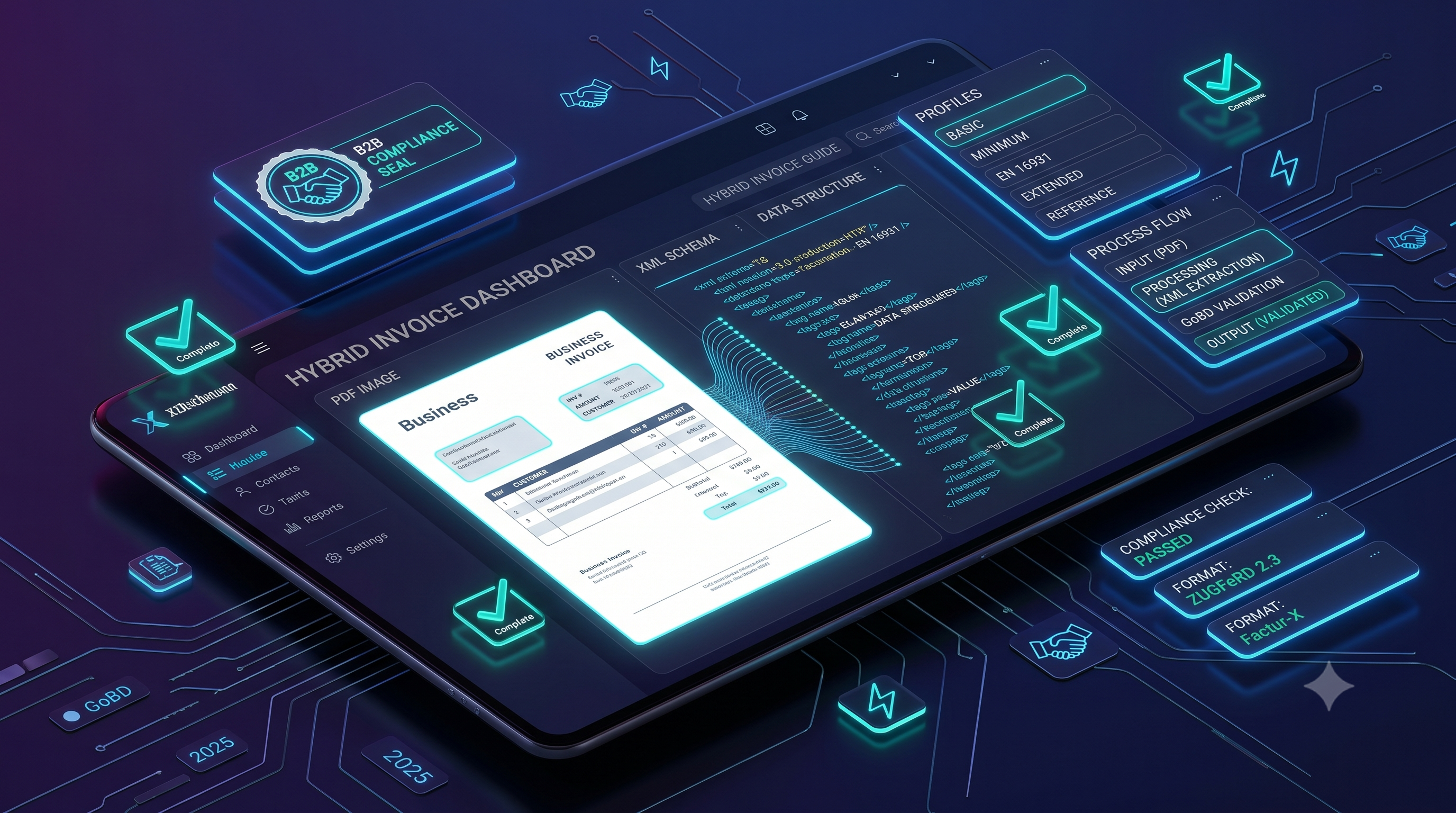
| Format | Pure XML-based dataset | Hybrid format (PDF/A-3 with embedded XML file) |
| Readability | Directly readable only by machines/software | Machine-readable (XML) AND human-readable (PDF) |
| Application | Primary for B2G (Authorities), increasingly B2B | Primary for B2B, but also B2G compliant |
Which format should you use? For federal public authorities, XRechnung is often mandatory. In the B2B sector, ZUGFeRD is highly popular because the visual PDF component eases the transition for employees used to visual checks.
Regardless of your choice, ensuring your XML files are valid is crucial. You can securely use our ZUGFeRD Validator to check your files, which also verifies XRechnungen for EN 16931 compliance.
5. Leitweg-ID: The Key to Government Communication
If you invoice public authorities in Germany, you will encounter a specific mandatory field: the Leitweg-ID. This unique identification number ensures an e-invoice is routed to the exact authority or department. Without a correct Leitweg-ID, an XRechnung will be rejected by central federal or state invoice receipt platforms. It must be entered in the "Buyer Reference" XML field.
6. How Do I Create and Send an XRechnung?
Manually creating an XML file is practically impossible due to its complex structure. You need a software solution to handle the background generation.
Step-by-step to your first e-invoice:
- Maintain Master Data: Ensure your company data (Tax ID, VAT ID, IBAN) and customer data are complete.
- Enter Invoice Items: Add services or goods as usual.
- Select Format: Choose whether to generate an XRechnung (XML) or a hybrid format (ZUGFeRD).
- Send: Transmit the file via email, Peppol, or API.
The easiest way for freelancers and agencies to start is by using specialized cloud tools. You can quickly create an e-invoice with our platform in just a few clicks. If you first want to understand the general mandatory content requirements (§ 14 UStG), you can discover our invoice templates to set up your basic data structure.
7. Receipt and GoBD-Compliant Archiving
Archiving is just as important as sending. According to GoBD (principles for the proper keeping and storage of books, records, and documents in electronic form), electronic invoices must be stored in the format in which they were received.
- Printing an XML file and filing it in a physical folder is not sufficient.
- You cannot simply convert the XML into a PDF and only save the PDF.
- The original machine-readable dataset must be archived unalterably for 10 years (audit-proof).
8. Key Takeaways
The XRechnung is triggering a fundamental automation of commercial processes in Germany.
- Structured Data over Paper: An XRechnung is a pure XML file. PDFs will no longer meet the legal B2B requirements.
- Action Required by 2025: By January 1, 2025, your company must be able to receive e-invoices.
- Archiving: E-invoices must be stored audit-proof in their original electronic format for 10 years.
Prepare your business now to save valuable time in invoicing and accounting!